Saturday, May 28, 2011

Kerala Backwaters


    As we approached the pier to begin our day, the comfort of cloudy skies diluted the sharp bright rays that are typically absorbed during the hours before high noon. The cool breeze blew briskly across the dark green fresh water of Lake Vembranrd, rippling in the slow churn of the diesel powered engine that propelled our houseboat for the day. We eagerly awaited a chance to step aboard the iconic vessel that dots the horizon of these dark waters from dusk to dawn. Here in the land of the coconuts, these boats are the face of ecotourism that has brought so many to the backwaters of Kerala. Now it was our chance to set sail on the water system that since the 1st century had been Kerala’s primary mode of transportation and exchange.

    Within minutes of boarding the one hundred and three foot vessel we were greeted by M.R. Krishna Varier’s, our guide and informant on the rich history of Lake Vembranrd, with ripe coconuts that were chopped and prepared as refreshments to combat the thirst spurred by the damp and relentless heat. Mr. Varier, we would find was one of the first to bring ecotourism to this part of Kerala, and has been operating tours for over 35 years.  It came at no surprise in the land of the coconuts that the canopy in which provided the cooling shade aboard our houseboat was hand built from native bamboo, and was tightly fixed with rope construed from coconut shells. As the crew pushed off and we escaped the thick marshy wetlands that dominate the lakes inlets, we gathered ourselves and prepared for a day on the water.

    Before the introduction of automobiles in Kerala, these house boats were the dominant form of transportation and were previously seen in greater numbers along the elongated man made canals that connected the southern tip of India. Today, the boats are abundant, yet the thought of busier waters became increasingly clearer as we advanced towards the narrow canals in which Keralites had settled more than a thousand years past in pursuit of rice patty cultivation.

    The distinction between the waters we traversed and the low lying patty fields became apparent as we entered the canals surrounded by the thick green vegetation.  The thin and manmade strips of land that divided the waterways were populated by local farmers, whose unique and earthy homes melted into the passing landscape.  It is astonishing to see life flourish as it does in Kerala, and never before had I observed a group of people live so simply in accordance with their surroundings.  As we passed we observed local men and women bathing in the cooling waters, barely acknowledging our foreign presence.  For these people life in the backwaters was ordinary and to our unfamiliar eyes the sight of life in these sparse strip of land construed pure inspiration and hope.  In our daily lives we are so utterly removed from the source of our resources, yet here in these canals, the source of their survival is all within sight. From the seemingly worthless shell of a coconut to the pain of hauling ones water for the day, nothing can be taken for granted and as it appears, nothing is.    

   After nearly five hundred clicks of my camera we arrived back at the pier of our departure with bellies full of local pearl spot fish, coconut water, Masala tea, and above all, as Bill McKibben emphasizes, a glimpse of what it means to live lightly on the earth.
    

Early Morning Thoughts

         It was a pleasant change waking up to sounds of nature. The bustling city of Trivandrum woke me up with the rude double-honks of cars communicating and navigating the reckless streets and the stuttering purr of the small, noisy Rick-Shaw engines starting up for early fares. But out here in Kumarakom, it was the quaint sounds of nature: nasally caws, high-pitched tweets, seesawing whistles, lulling palm leaves and rippling waters.
        I slid the door out onto the balcony of our hotel room and heavy air immediately sagged my shirt as I gazed out at another musky morning. I begged for a cooling breeze as I scanned the early-morning horizon, the sun still hidden behind a humid haze. “This is the India I came to see,” I thought as I stared out over the lake. A slender, shirtless man propelled a small skid through the water with a long bamboo pole, his white, wispy beard trailing in the wind. I thought of Hemmingway’s Old Man At Sea as the scrawny man propelled the boat with ease, lifting and switching the bamboo to hold a straightened course.

        Suddenly, a motorboat plowed into view, a whitewash wake forking behind it as it swerved carelessly to the screaming enjoyment of its passengers. Something seemingly trivial, but it struck a chord with me. Perhaps it was a sign of something much greater, a transition in Kerala, or maybe the more operative word would be an 'invasion.' An invasion of Western ideals, of capitalism, of neo-liberalism taking hold in this distant east land: the growth of a wealthier class slowly emerging from the masses.
        As the sun broke through the hazed horizon, new sounds began to take hold. The vrooming purr of motorboats and houseboats faded out nature’s morning calls as the paddy field tours began. Their passengers weren’t Westerners, but Indians, from Punjab and other richer Northern states. They had travelled down to visit what was remaining of India’s natural beauty and untainted wilderness. To witness communities still living with nature, still washing their clothes by beating them on stones by the river, still building their homes from felled trees nearby, still growing food and livelihoods from the soil of the small plots allotted to them. But these new sounds, the purring engines, they were sounds of change: the sounds of a world of less, slowly, but surely, transforming into a world of excess.

Friday, May 27, 2011

From Poznań to Kochi


Now, it is time for Kochi…

         Kochi is one of the most beautiful Indian cities I have seen. Especially when oversized and overpopulated places like Delhi are not your favorites. The region of Kerala and Kochi itself can be a great alternative to the North of India. The coast gives humidity, and temperatures here are lower than in Delhi.
To Kerala sailed and here died Vasco da Gama, and along with him Poznańer – Gaspar da Gama, who next to such Poznańers as Paweł Edmund Strzelecki and Kazimierz Nowak, has extraordinary biography of a discoverer. Some people believe that he also died in Kerala. In Kochi, in the church of St. Francis, nota bene, the oldest in India, was the tomb of Vasco da Gama – was, because his body was moved to Portugal few years after his death. Kochi is also famous for the oldest in India synagogue - it used to be a vivid center of Indian Judaism. The Chinese fishnets are very interesting piece of landscape here - the net is attached to a high pole and operated with the force of four or five men. This method survived untouched for hundreds of years, and until now feeds people of Kerala as well as coming to her tourists.


Lukasz W. Niparko

Thursday, May 26, 2011

National Park(ing)


     Today, I could discover that tourism can lead to the evolution of the National Park into a tourist trap. An artificial lake, metal oil run boats, hundreds of tourists clumped together – all of these under the name of Periyar National Park – also known as Thekkady (which is the name of a closest city to this place, famous of its marital art - Kalarippayattu). This place rich in beautiful nature, elephants, birds, hills, and forests –is also filled with wastes from the oil-boats, trash, noises coming from dozens of vehicles trying to as fast as possible deliver tourists to the park. Multiple rickshaws and cars make the entrance to this National Park, a real National Park(ing)! Some also could say that anyway this is better than nothing, easily it could be there a housing estate or an incinerator instead of this beautiful natural world it is just so difficult to satisfy us human and at the same time protect the nature (this is so true for all of us, in Poland, in the US, everywhere).

* In the heart of the Park there is a reserve dedicated to the restitution of tigers’ population. This reserve is not accessible for tourists.


Lukasz W. Niparko

Wednesday, May 25, 2011

Plantations


Kerala has seacoast and lowlands on her Western border, but going further we meet highlands and hills that for me who comes from Poznań in the middle of flat Wielkopolska – those hills are real mountains. On this hills/mountains originates tea – the product that we can find in (I am almost sure) every Polish home. Before we discovered that we can drink it, tea was growing much higher than today, now it is ‘adjusted’ to the height of people picking its leaves. It is hard to believe when you stand in the middle of such plantation that one day ‘all of these’ will end up in a teapot.


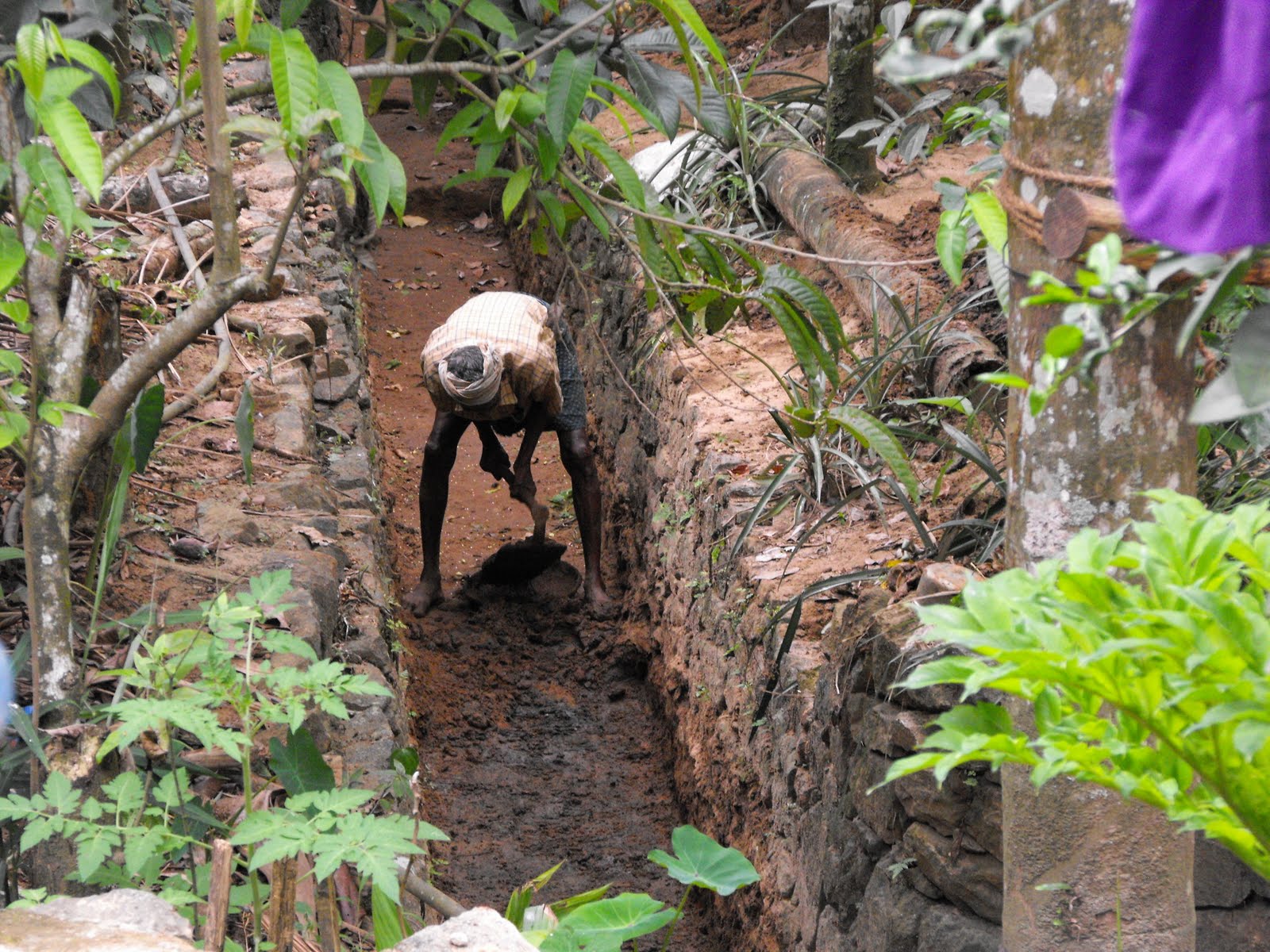
Big plantations, and ‘big’ planters, honestly to me, do not fit in the socialistic picture of Kerala, even when they make only one percent of the population of this region; they have thousands of hectares what puts the system of that place called “Socialism” in a weird “limbo.” It seems that the Socialists of Kerala skipped the chapter on ‘de-kulakization’ in constructing their Socialism, keeping plantations as the exception that brings large profits. Plantations are not all about tea, but also give natural rubber, pine apples, pepper, and other products – sold to other parts of the world for much higher prize. (On the picture you can see below is a man cleaning the melioration ditches and women coming back from picking up tea leaves).


Lukasz W. Niparko

Tuesday, May 24, 2011

They Demand RESPECT

While visiting Kerala, Southwestern part of India, no one should miss  Kerala’s spectacular Backwaters that in the past were used as rice plantations, but today became a tourist attraction showing, both natural beauty and the sustainable way human can utilize the natural environment with respect to the nature. The Backwaters are also witnesses to the multiple transformations through which Kerala has gone in the past decades – from colonialism through socialism, to… tourism which plays an important role in the local economy today. And, tremendously affects the Backwaters and their inhabitants.

In such places like The Backwaters that became a point of interest to the tourists from all over the world and the place of establishment of vast resorts; the model of relative equality that has been created since 1957, (the first elections in the world won by the Socialists), is under the thread. Tourism made here a new model, much more similar to the feudal/colonial past, than desired by the Socialists and workers equality – the model of exploitations that silently takes place behind the high walls of resorts. Here tourism affects almost every sphere of people’s life.
Resorts, founded by the foreign capital or the capital of those who emigrated from Kerala to the Middle East (1/6 of Keralites has done so), are being ruled as Greek polis – they are countries within themselves, except that there is no place for democracy there, and that the strata of ‘quasi-slaves’ is very developed there, existing next to the strata of their masters, and unaware of anything tourists. Once the worker of a resort crosses the gates, has to obey any demand of his ‘master’ who often does not obey any workers’ conduct, including restricted time of work. It is very sad that those places with plasma TVs, fitness centers, and swimming pools—five star quality—have a common trait: the exploitation of workers that on the scale reaches ‘negative’ five stars margin.

This new order is very difficult to accept especially to inhabitants of Kerala, who since 1957 have embraced the workers unions and strive for the respect for everyone. This achievement is being dismantled nowadays, by the management of resorts, who prefer not to see the unions on their background. Those who do not accept the new order of things or humiliation – have to leave, some begin to resist…
I had a chance to witness such resistance by driving on the streets close to resorts. Honestly, for the first time when I passed the strikers I thought they are a bunch of men wanting to make money by selling socialist flags with its easily distinguishable hammer and sickle. However, when I stopped to talk to them it turned out that they are workers on the strike, who insist on staying on that place few meters from the gate of the resort where they used to work. There were about 10 to 15 men there, trying to voice grievances and argue for their rights in heat hovering around of 30 degrees Celsius or about 86 degrees Fahrenheit. They have been there since May 2nd. They said that if this would not help, there will be other unionists coming from the regional office; if this will not help… there will be more serious protests; I am afraid that this might involve violence—these men are desperate. Their postulates are not sophisticated in regards to what someone who watches them may think – they do not want higher wages! They only demand respect; respect that was refused to them and their colleagues behind the resort’s gates.
The resort in which they used to work has five stars standard - not in every aspect as we see in regards to the treatment of the workers. The resort is funded by capital that is in India located in Bangalore, but in fact comes from the Middle East the workers say. This company has also its branches in the United Kingdom. Moreover, the chapter in Kumarakom was named among the best in India.
      
   As I thought about this situation, it occurred to be the “double movement” of resistance towards the free market system described by Karl Polanyi in his Great Transformation (1954), and was shown in action on the streets in Kumarakom. Unfortunately, without recognition of the local media or the resort’s management that was the subject of the protest, the former workers were isolated and their rights ignored, or so it seems. The only acknowledgment was made by the local police that appeared after approximately 10 minutes of our talk with the former workers, going back and forth on the street, where they have their camp. However, based on other talks with the locals there is a lot of sympathy towards the protesters there, but not everyone one protests; there are some workers who chose to remain in bad working conditions to not lose their income. Yet those we met trusted that our presence and our awareness can bring some change.
Such resorts are a real ‘ticking bomb’ for Kerala’s environment – they are ready to build their hotels and spas even in the most precious ecologically vulnerable places such as the Lake Vembanad that in the past years has became a victim of tourists who cruise on so called ‘housing boats’. A criticism of this atrocity against nature is countered with points of view about employment – what would all the people of Kumarakom do if the resorts will not be there? It is further emphasized that given the reality that Kerala does not let much foreign direct investment to come in, most likely the only fate for them would be to immigrate to some Middle Eastern or Western country and send money back to their families in Kerala. We observed this pattern well while staying in Kerala where the new houses being built by Kerala workers who are not in the region. We can only guess the actual numbers of workers from Kerala and their conditions in other lands…, but what we know for sure is that working conditions of Kumarakom’s resorts have to change. After all this is a tourists’ choice to not support the place that does not support human rights.

Lukasz W. Niparko

Kerala's Backwaters and their Citizens


  Those days we spent on the Backwaters of Kerala that used to be in the past enormous plantations of rice, and a birthplace of the workers struggle for the change that culminated in 1957, with the first elections won in the world by the Socialists. Today, the Backwaters are mostly a tourist attraction, yet many problems that were present a hundred years ago are still here. We could hear about some of them in the local orphanage that is inhabited by girls, boys, and in some cases also mothers with their children, and abused women.

We met there– Gale, about a 40 years old woman, who belongs to the British-Indian family, speaking fluently in English, and who dresses like us in ‘supermarket clothes’, not traditional Indian clothes that wear other women in that place. Our talk with Gale has opened our eyes for the hardships women go through in Kerala, what includes abuse, alcoholism of their partners, discrimination, and a total lack of rights in the society that they face on daily basis.

Some of the Keralites say that this all because of the colonialism and the British – they replaced Kerala’s pre-colonial matriarchy with the domination of males. Some also praise the rule of Socialists as the reason of women well-being in Kerala. As a matter of fact, the infanticide of girls is much lower here, and the gender structure in Kerala is much more ‘natural’ than in the rest of India where girls are aborted; however still the problems of dowry, of discrimination, of marginalizing women, are present also in this ‘Socialists’ paradise’.


Gale is taking care of Dixon, a four years old boy, who is very energetic and extremely joyous. Unfortunately, once he turns five she will have to ‘give’ him to another institution; here orphanages separate girls and boys. Other woman, Sharon, in the third month of pregnancy, was crying all the time while we stood there– she knew that her baby can be affected by high fever she had, probably caused by malaria. For women like Sharon and Gale there are no perspectives in India; of course many women today become CEOs and are very successful, but in the countryside and small states like Kerala not so much of it. And on the other hand, it is not the point that every women and men should be a CEO in order to be happy, the point is that their status should be equal, and life should be normal, and this for sure is not the case in India. The same with the kids in this orphanage – they will inherit poverty and misfortune, and pass it to the next generations. However, we can also ask is it only here? Or, is our world like that? Is the fate of marginalized people in the USA or Poland much better? For example, the Poles who live in the former state-owned Agricultural Farms [PGR – Państwowe Gospodarstwo Rolne] have also no chance for improvement of their life conditions, their problems are unheard, and poverty is being inherited by the future generations. […]
         
We also visited the private school lead by Mary Roy, a mother of Arundhati Roy, a well-known Indian activist and writer (famous for her book “The God of Small Things”). Her mother in the past neglected Indian patriarchy and made a lawsuit in front of the Supreme Court challenging the law of inheritance that discriminated women. Being without resources and with two daughters she started her own school to give her daughters equal chances, her home-schooling evolved into one of the best schools in Kerala, and her daughters to women who are not silent for discrimination and marginalization of others.


Lukasz W. Niparko