Sunday, June 26, 2011


Bija Vidyapeeth -- "School of the Seed"
Warming dew dampened my bare feet as I trotted through the tall grass that blanketed the berm dividing the two cultivated plots to either side. The sun snuck through the tall trees to my east and though its newborn rays barely reached my feet at that point, I felt its emanating warmth tickle my toes. More berms jutted out from either side of the central path I walked upon, dissecting the two larger plots into ten or so smaller plots. During harvest season these small plots grow hundreds of different varieties of seed, to name a few: lentils, eggplants, thyme, rosemary, mint, lemon balm, okra, coriander, chilies, ginger, turnips, mustard, barley, millet, any number of their 500 paddy strains and 80 races of wheat. A collection that makes Navdanya’s farm a true crown jewel of biodiversity, and not just in India.
Navdanya didn’t always boast such diversity, once a barren monoculture, it took five dedicated years to transform the lush, loamy soil. Starting in 1987 as a movement for seed conservation and empowering and protecting the local farmers of India, Navdanya’s influence has grown with it’s soil and seed over the years: slowly enlightening its entire community to the wealth of organics.
The seeds sewn here almost make it through their entire sequence of life: they are planted, given time, sun and water enough for them to germinate, sprout, bare fruit, flower, and just before their seeds fall back into the earth to become the children of next years harvest, they are collected and stored in Navdanya’s Seedbank.
Meandering along the berm path through bigger fields, more smaller seed plots and forest gardens, I eventually came across the seedbank. A group of workers washed mason jars outside and smiled as I entered the building through a door on the left. The small structure was made of the earth: mud, clay and cow dung shaped the walls, with straw used as the fiber to give it congealing strength (like rebar in cement buildings). The thick, earthen walls kept it cool, like an above ground root cellar, and a northern facing window cast light, but not heat into the room. Hundreds of jars filled glass-paned cabinets throughout the room, and flowered grains and chili plants hung from a string on the ceiling as they dried and waited for their seed to be extracted and stored. The cabinets had labels delineating their contents: medicinal plants, ornamental timbers, spices, oil-bearing seeds (like mustard), vegetables, legumes, cereals and millets. The room adjacent to this one had larger vats containing greater quantities of seed. These seeds were given free of charge to farmers hoping to start organic farms, or already practicing and lacking the money for seed. The farmers then grow the plants, harvest the produce, and collect the seed. For each kg of seed borrowed from Navdanya, they must return 1 and a ¼ kg to keep the seed variety alive, and so future farmers can enjoy the fruits of seed sovereignty.
Outside the seedbank my nose followed the distinct scent of cows that led me past the stables, earthen-made as well. The distinct sounds of cow’s off-center chews distracted me as I watched their tails lazily wag flies off their backs. Soon, I noticed a big blue container standing outside. After curiously poking inside and observing the strong scented, yellow liquid within, I stopped and pondered.
“It is what you think it is,” a worker told me as he noticed my query. “It’s cow urine.”
I’d heard of cow urine’s incredible uses for pesticide and plant nutrition, and some farmers had began replacing their synthetic fertilizers with this otherwise wasted byproduct…But Navdanya added a new property to its list of alleviations: a health elixir….for humans.
“1 Tsp. each morning does wonders on human health…I take it myself.” The man told me.
After pondering the taste of cow-urine, I moved my mind onwards to another barn just past the stables. Long, skinny, brick-laid rectangle spanned the barn, only about six inches high, but they guarded thick plots of soil. Reaching a hand and turning the soil could reveal hundreds of skinny, red wrigglers with each handful. The worms ate and digested the soil, turning it into potent, organic fertilizer after only a few weeks. Small amounts of this could be spread over entire acres, saving time, money, and a debt-ridden dependence on commercial fertilizers.
Outside the vermiculture barn stood a large clay container that looked like a tall, skinny barrel. The container was usually piled up with 6 inches of small rocks, 6 inches of pebbles, 6 inches of sand, 6 inches of manure, a thin layer of worms, and some loose hay on top. Above the open-top barrel hung a small bucket with tiny holes punched into its underside that allowed for water to slowly drip into the layers below. After gradually filtering through the system water was collected from the spout below and spread over the crops to suppress diseases, and provide nutrients for plant growth. This “compost tea” is a safe, affective and cheap alternative to synthetic varieties.
I started back towards the path along the grassy berm. I gazed as a slew of radiant butterflies danced in the morning sun, I could hear the hum of honeybees out on morning patrol, buzzing, chirping, and insect gossip all began to fill the air around me; I paused for a moment and allowed my senses time to catch up, and I realized, this place is truly a haven for life of all kinds. Navdanya is a hallmark of biodiversity, seed conservation, and organic farming techniques that save time, money, and empower the farmers who use them. Navdanya’s uses for manure as fertilizer, pesticides, herbicides and heating redefine what is waste on the farm. Their efforts in seed conservation have reclaimed hundreds of India’s indigenous seed varieties. Navdanya’s efforts helped pushed their state of Uttarakhand to declare itself a Genetically Modified free state. But their sphere of influence doesn’t stop in their direct communities, but with their half a million famers in India, and their many supporters abroad; which makes Navdanya a true beacon for change in a world becoming vastly dependent on unnecessary resources.

Thursday, June 23, 2011
Childhood Malnutrition
 |
| Growth and Development Charts |
The NGO COCOEDECON took us on a day trip to the town of Tonk, which is located in the Indian state of Rajasthan, on the eastern border of Pakistan. The approach to the village was a scenic drive, which involved winding dirt roads and a picturesque mountain landscape. When we actually arrived at the village school, the scene, which greeted us could not have been more different. We were warned, before we exited the bus, that talking to the swarm of children who encircled our vehicle would be a bad idea because they would expect gifts from us (especially food or money) and if we acknowledged them, then it would encourage the swarm to follow us. The professors singled me out for a specialized reminder because children are my most dangerous weakness. It was hard to stare straight ahead, when we were ambushed with such innocent and deprived little ones.
 After dodging in between the masses of youngsters, we entered into the one room schoolhouse, where posters covered every square inch of space, some in English and some in Hindi. The posters reminded children to have healthy eating and hygiene practices, in addition to listing the activities of the day. The COCOEDECON guides posed our questions in Hindi to the villagers who gathered in the classroom to meet us. They showed us a chart where the teachers tracked the growth rates of the students and introduced us to the locals. At one point in the discussion they told us that they were going to bring in an example of a malnourished person.
 A slight-framed twenty-year old mother slid cautiously into the room, two children attached to her withering form like leeches. We were informed that the younger boy with tears in his eyes and an otherwise expressionless face was malnourished. At two years old he couldn’t walk. His older brother used to be malnourished, but now by the age of five, with the assistance of COCOEDECON, he was doing a lot better. I am constantly around children, whether it be at family gatherings (as the eldest cousin on both sides of the family) or in my constant babysitting. Usually, I can smile or make a face and get at least a glimmer of recognition if not a return smile from a child. The little malnourished boy looked right through me, like a ghost, incapable of emotion or normal human existence by virtue of the fact that he is not given access to proper nutrients, one of the most basic needs for any creature.


Source: “India: Malnutrition Report.” The World Bank.http://go.worldbank.org/TUTLNHSPH0 World Bank Group: 2011.
Monday, June 20, 2011
The Sikh Temple

We finished up our dinner in downtown Delhi and headed home as a very united, satisfied, group. As we strolled along, we took in the night villages, which pop up as the sun falls down. Children ran about scavenging for food or money and were summoned back to their parents for sponge baths in the middle of the square. People were everywhere, scattered about on benches and cardboard cutouts. Indian women lurched toward us, offering henna tattoos and bangles- “Special price. Only for You”. A wealthy woman strolled by in her exquisite saree and jumped into a car, seemingly oblivious to this unfolding scene. We continued on and saw a golden dome looming prophetically above a scarf-selling stall. A random man came over stared at us
 and said “Beautiful”, before walking away.
 We pulled out our cameras and instantly captured the moment. Mesmerized, we weaved our way across the crowd following a continuation of the same scene. Stray dogs fighting. Street vendors pushing. Children washing. Several different entrances with attached parking lots led to this central mecca of the Sikh Religion in Delhi- The Gudwara Bangla Sahib. It was created in honor of Harkrishan Dev, the eighth Sikh guru. He was in this very area, where the temple was constructed in 1664, for many months in order to better the living situation at the time for the ill and the poor. (136) As we approached the temple, we were overwhelmed by the smells and sights. Food was readily available- both to purchase and to eat for free. We stood for a long time deciding whom to send in as our scouts with the requisite headscarf. However, all of our musings were put to an end when a kind woman pointed over to the shoe minders and explained that they had scarves to lend out. We piously approached the ‘in’ and ‘out’ gated lines and turned in our shoes in exchange for numbered chips. Then we passed through the area where worshippers systematically stepped into a footbath and washed their hands in a communal sink. After that, our group walked up the huge walkway leading up to the entryway where we tried to imitate the bowing movement that the other visitors completed as they entered the building. We were immediately approached by a kind man who sat down with us on the rug and thoroughly explained his beliefs.
In the Sikh religion, there are five Kakkars or emblems: kesh (not to cut one’s hair for saintliness), kangha (to keep the hair in good condition), kaccha (loose-fitting undergarment, designed to exude modesty), karpan (knife which represents power and dignity) and karra (steel bracelet, which stands for fearlessness). All of these items are to be worn and all of these practices are to be followed at all times. Even when Sikh followers shower, they must keep these objects attached to some part of their body. True followers do not drink alcohol, cut their hair, indulge in a woman other than their spouse, or use their knife except to protect an endangered woman. Sikhs call themselves “Singh” which means “lion”. Langar is a meal offered in the basement of the temple, which is free to all people no matter what their caste or class or age ranking or religious inclination. (71)
Sikhism arose from people who felt that Muslim or Hindu rituals and beliefs were unfulfilling as well as unjust. It holds true to the same principles of rebirth and karma, but deviates from what Sikhists feel are other unfavorable religious restrictions in those religions. Guru Nanak, the founder of Sikhism, believed in the equality of all people regardless of caste, which was very forward thinking for his time. His frustration with other religions was spurred on by the fact that only Brahmins were allowed to perform the highest of sacred procedures in other religions at the time. He lived from 1469- 1539. He preached that meditation was critical and could lead to miracles. The Guru Granth Sahib showcases the preaching of the 10 Sikh gurus.
This experience was not only significant in terms of the facts that we learned. Instead, it had a tremendous impact because it showed us the importance of religious tolerance.
Works Cited: Singh, Sarina. “India”. Lonely Planet. 13th edition. USA: Sep 2009.
Monday, June 13, 2011
GMOs effecting US milk industry
While staying at Navdanya Institute in Dehra Dun our group was fortunate enough to sit down and have a Q&A session with global food activist, Vandana Shiva. She is an absolute mountain mover and I swear I had an out of body experience while talking with her. Shiva has essentially waged war against seed modifying corporations like Monsanto, for they take away biological diversity and farmer's independence. Here's an article I came across on Public Radio International shedding light on the immense power the private food corporation has in deciding what we add to our bodies.
Monsanto strikes again
Paige
Monsanto strikes again
Paige
Sunday, June 12, 2011
Northern Monuments
Although monuments are not covered under the Melon Grant, as a group we found that visiting many of the world famous landmarks was an important cultural experience while we were in India. We dished out our own rupees so we could see some magnificent forts and one of the man made wonders of the world.
In the center of the bustling area of Old Delhi rickshaws motor by, and street venders yell down the crowded, narrow streets. The alleyways are dimly lit, there is an overwhelming amount of old wires knotted around cement poles, and the smell of street food saturates the air. It is a scene worth experiencing. The towering Red Fort acts as a backdrop to all of this and dominates most of the skyline. A group of us walked through metal detectors and were welcomed through red sandstone arches by armed Indian soldiers.
The fort was built in 1648 by Mughal emperor Shan Jahan as a residence for the royal family of India. At one point the fort housed about 3,000 people. Inside the fort it seems to go on forever. There are areas for fountains, gardens, a photography museum, and a lot of area the public cannot see because it is under military occupation. The next time I’m in Delhi I want to go to the Red Fort at night time to see the light show that is put on every night.
When we got to Agra I expected our only monument that we saw to be the Taj Mahal. Much to my surprise the Agra Fort was my favorite monument of the trip. Similar to the Red Fort, it is partly occupied today by the Indian military. It is 94 acres and beautifully made out of red sandstone. The fort is surrounded by a mote and located on the Yamuna River. Inside there are places where spies used to hide, areas for dancing, and a palace where the emperors used to live. The emperors that had lived there in the past left very distinct evidence of their architectural differences, each having their own area built in very different styles. At the top of the fort there is a nice view of the Taj Mahal set a few kilometers away. Its milky color blended in with the hazy sky. It made many of us very excited to see it up close.
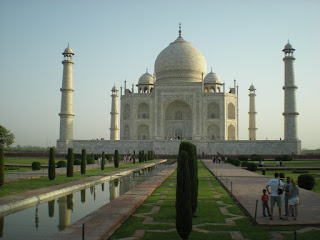
The next morning we all woke up around 5am to walk from our hotel to the Taj Mahal. We were told that seeing it around sunrise was not just the most beautiful and physically cooler times of the day to see it, but also the least crowded. Our great tour guide lead us to the entrance where you are unable to get a good view of it before you come in. After going through security we turned the corner and saw the beautiful ivory colored mausoleum, one of the most recognized structures in the world. The Taj Mahal is known around the world as a symbol of eternal love because the Mughal emperor Shah Jahan built it in memory of his third wife, the same emperor to build the Red Fort in Delhi.
The perfectly symmetrical building casts a mirror image of itself in the water that sits in front of it. I wish we could have spent ours there just sitting and looking at it. Inside the beautiful white marble continues and the walls are perfectly dressed with stones and jewels from all over the world. It was spectacular.
We were one of the first groups to get there in the morning and it was totally worth waking up early. Even being there for just over an hour, it was clear that it was getting much hotter out and more crowed. I would highly recommend stopping by Agra to anyone going to India to see these two monuments.
The monuments were one of our very few personal expenses on the trip and I am very happy we visited them. In addition to being just interesting to see, it also provided a historical background on some of the topics we were studying, especially the development of India. They were both beautiful to see as well as being educational at the same time.
The Red Fort

The Agra Fort

The View of the Taj Mahal from the top of the Agra Fort.

The Taj Mahal!

In the center of the bustling area of Old Delhi rickshaws motor by, and street venders yell down the crowded, narrow streets. The alleyways are dimly lit, there is an overwhelming amount of old wires knotted around cement poles, and the smell of street food saturates the air. It is a scene worth experiencing. The towering Red Fort acts as a backdrop to all of this and dominates most of the skyline. A group of us walked through metal detectors and were welcomed through red sandstone arches by armed Indian soldiers.
The fort was built in 1648 by Mughal emperor Shan Jahan as a residence for the royal family of India. At one point the fort housed about 3,000 people. Inside the fort it seems to go on forever. There are areas for fountains, gardens, a photography museum, and a lot of area the public cannot see because it is under military occupation. The next time I’m in Delhi I want to go to the Red Fort at night time to see the light show that is put on every night.
When we got to Agra I expected our only monument that we saw to be the Taj Mahal. Much to my surprise the Agra Fort was my favorite monument of the trip. Similar to the Red Fort, it is partly occupied today by the Indian military. It is 94 acres and beautifully made out of red sandstone. The fort is surrounded by a mote and located on the Yamuna River. Inside there are places where spies used to hide, areas for dancing, and a palace where the emperors used to live. The emperors that had lived there in the past left very distinct evidence of their architectural differences, each having their own area built in very different styles. At the top of the fort there is a nice view of the Taj Mahal set a few kilometers away. Its milky color blended in with the hazy sky. It made many of us very excited to see it up close.
The next morning we all woke up around 5am to walk from our hotel to the Taj Mahal. We were told that seeing it around sunrise was not just the most beautiful and physically cooler times of the day to see it, but also the least crowded. Our great tour guide lead us to the entrance where you are unable to get a good view of it before you come in. After going through security we turned the corner and saw the beautiful ivory colored mausoleum, one of the most recognized structures in the world. The Taj Mahal is known around the world as a symbol of eternal love because the Mughal emperor Shah Jahan built it in memory of his third wife, the same emperor to build the Red Fort in Delhi.
The perfectly symmetrical building casts a mirror image of itself in the water that sits in front of it. I wish we could have spent ours there just sitting and looking at it. Inside the beautiful white marble continues and the walls are perfectly dressed with stones and jewels from all over the world. It was spectacular.
We were one of the first groups to get there in the morning and it was totally worth waking up early. Even being there for just over an hour, it was clear that it was getting much hotter out and more crowed. I would highly recommend stopping by Agra to anyone going to India to see these two monuments.
The monuments were one of our very few personal expenses on the trip and I am very happy we visited them. In addition to being just interesting to see, it also provided a historical background on some of the topics we were studying, especially the development of India. They were both beautiful to see as well as being educational at the same time.
The Red Fort

The Agra Fort

The View of the Taj Mahal from the top of the Agra Fort.

The Taj Mahal!


Saturday, June 11, 2011
New Delhi
New Delhi, the capital city of India, famous of its monuments, political life, developing each day, dynamic metropolis – it is spectacular but also a shocking place. Spectacular buildings established by Hindu and Muslims – such as Qutub Minar (the highest in the world minaret), the Red Fort, Humayun’s tomb… what is shocking the most – the streets… the streets on which dwell children, elderly, women and men – there are no exceptions. There is only one rule – the rule of streets, and one fate – the fate of poor people. The law of marginalization which makes them invisible to many eyes; invisible because they do not fit to the modern architecture of neo-liberal capitalism, nor they fit the statistics of the positive economical growth. Street dwellers have their own statistics and their own politics – of surviving from day to day. Although they are invisible to the politicians, they can be seen all over Delhi, laying on the lawns, benches, and the bus stops. They fill every empty spot of the city which has officially 12 million people; unofficially: No one knows! Because no one is willing to count people who live inside the cardboards. Poverty is not surprising, what is surprising is the indifference for poverty. The indifference also of those people who stubbornly claim that “everything is all right until we can note the positive economical growth,” moreover who say that “people who live in the poverty are only byproducts of development.” Yet, no one cares that the same people are thrown away from their homes just because ‘someone’ has its plan to build a dam or to establish Special Economic Zone.

When after three weeks of being in India, I landed at my home-airport in Poznań, I understood that relative social equality – it is a real treasure, of course we are not the best in it, but the Bukowska Street for sure does not look as the streets of Delhi – and here appears our duty, to keep our streets like that, or even improve them, and to bring more equality to those in India, in addition to that we should try to bring more awareness to those streets all over the world where residue corporations and governments, and those who are luckier – who live in villas or in vast apartments, because the awareness is the first and the most important step towards the change. When the world will start the awareness campaign? For now, the colorful magazines talk exclusively about the charming monuments, TVs about the Bollywood stars, and we – we keep saying that “this is not our problem…”
Subscribe to:
Posts (Atom)